|
About Sails
Parts
of a sail

Diagram showing the names
of the parts of a sail. The luff is the
forward edge.
In
sailing the parts of a
sail have common terminology. Most sails are now
triangular; for such sails, there are six separate
terms, one for each
corner and edge.
The corners
In a triangular sail,
the upper point is known as the head; the
halyard, the
line which raises the sail, is attached to the head.
The lower two points of the sail, on either end of the
foot (the bottom edge of the sail), are called
the
tack (forward) and clew (aft). The tack
is shackled to a fixed point on the boat, such as the
gooseneck in the case of a
mainsail, or the deck at the base of a stay, in the
case of a
jib or
staysail. The clew is movable and is positioned with
running rigging. A symmetrical sail may be said to
have two clews.
Clew
The clew of a jib or
other
headsail is the free corner (not attached to any
standing rigging), to which port and starboard jib
sheets are attached to control the angle of the sail
to the wind.
In a sail with a
boom (such as a mainsail on a
sloop), the clew is attached to the boom, and can
often be tightened along the boom using the
outhaul to adjust the sail shape.
On a
square sail or a symmetrical
spinnaker, each of the lower corners is a clew, but
the corner to which the sheet (the working sheet
or leeward sheet) is currently attached is called
the clew.
The edges

The edges of a
quadrilateral fore-and-aft sail.
The foot of a
sail is its lowest edge, bounded by the clew and the
tack, or on some sails by the two clews. The forward
(leading) edge of the sail is called the luff.
This is related to the term luffing, which is a
condition where the sail ripples because wind is
crossing over the front and back side simultaneously,
caused when the angle of the wind fails to allow the
sail to maintain a good aerodynamic shape; this
condition usually starts near the luff as the boat
passes through being
close-hauled. A
cunningham may be rigged on the luff of the mainsail
to help control the sail shape.
The aft edge of a
sail is called the leech. If incorrectly
tensioned, the leech of a sail may "flutter" noisily;
some larger mainsails are provided with a line which
runs along a pocket in the leech, called a leech line,
for the purpose of tightening the leech to prevent this
fluttering.
The roach
The shape of a sail
is seldom a perfect triangle. It is common for
sail makers to add an arc of extra material on the leech,
outside a line drawn from the head to the clew. This
additional part of the sail is known as the roach;
mainsails usually have roaches, but they are very
occasionally found on specialist jibs as well. They
provide additional power for a given mast/boom size.
Since it cannot be
supported by tension in the sail material (applied from
the corners), it would flap uselessly unless some other
provision were made for it. It is therefore supported by
battens, held in batten pockets, which extend
into the main portion of the sail.
Non-triangular
fore and aft sails

The corners of a
quadrilateral fore-and-aft sail.
Gaff,
gunter,
lug,
junk and some
sprit sails have four sides but are set fore and aft
so that one edge is leading. That is, the luff.
tack, foot, clew and leech
are the same as for the triangular Bermuda sail. But the
high aft corner is the peak and the top edge is
the head. The corner between the head and the
luff is the throat.
Square Sails

The parts of a square
sail.
Although most sails
used today are triangular and follow the conventions
above, square sails are still used on a few vessels.
Many of the same names are used for parts of a square
sail.
- Head
-
-
As for a triangular sail,
this refers to the topmost part. On a square sail,
however, this part is an edge rather than a corner.
-
- Leech
-
-
The "side" edge of the sail.
Since square sails are symmetrical, they have two
leeches. Occasionally, when the ship is
close-hauled, the windward edge of the sail
might be referred to as the luff.
-
- Clew
-
-
Like a triangular sail, the
"free" corners of a square sail are called clews;
again there are two of them. Square sails have
sheets attached to their clews like triangular
sails, but the sheets are used to pull the sail down
to the yard below rather than to adjust the angle it
makes with the wind.
-
- Foot
-
-
The bottom edge of the sail.
Square sails also have
tacks and sheets, although they are not a part of
the sail itself.
Mainsail
A mainsail is the most
important sail raised from the main (or only)
mast of a sailing vessel.
On a
square rigged vessel, it is the lowest and largest
sail on the main mast.
On a fore-and-aft rigged vessel,
it is the lowest and largest and often the only sail
rigged aft of the main mast, and is controlled along its
foot by a
spar known as the
boom. A sail rigged in this position without a boom
is generally called a
trisail, and is used in extremely heavy weather.
The modern
bermuda rig uses a triangular mainsail as the only
sail aft of the mast, closely coordinated with a
jib for sailing upwind. A large overlapping jib or
genoa is often larger than the mainsail. In downwind
conditions (with the wind behind the boat) a
spinnaker replaces the jib.
Traditional fore-and-aft rigs used
a
gaff to control the top of the mainsail, sometimes
setting a
topsail above it.
|
Sails,
Spars and
Rigging |
|
Sails |
|
Course |
Driver |
Extra |
Genoa |
Gennaker |
Jib |
Lateen |
Mainsail |
Moonsail |
Royal |
Spanker |
Spinnaker |
Spritsail |
Staysail |
Studding |
Tallboy |
Topgallant |
Topsail |
Trysail |
|
Sail anatomy and materials |
|
Clew |
Foot |
Head |
Leech |
Luff |
Roach |
Tack
Dacron |
Kevlar |
|
Spars |
|
Boom |
Bowsprit |
Fore-mast |
Gaff |
Jackstaff |
Jigger-mast |
Jury Rig |
Main-mast |
Mast |
Mizzen-mast |
Masthead Truck |
Spinnaker Pole |
Yard |
|
Rigging components |
|
Backstay |
Block |
Boom vang |
Braces |
Buntlines |
Cleat |
Clevis Pin |
Clewlines |
Cunningham |
Downhaul |
Forestay |
Gasket |
Gooseneck |
Guy |
Halyard |
Outhaul |
Parrell beads |
Peak |
Preventer |
Ratlines |
Rigging (Running) |
|
Rigging (Standing) |
Sheet |
Shroud |
Stay mouse |
Stays |
Throat |
Topping lift |
Trapeze |
Course (sail)
In
sailing, a course sail is the principal sail
on a mast.
This term is used predominantly on
square rigged vessels, referring to the largest and
lowest sail on each mast (mizzen-course, main-course and
fore-course).
Gaff-rigged vessels might possibly use the term (for
the lowest sail rigged aft of each mast), but are more
likely to refer simply to a mainsail, foresail, etc. A
Bermuda- or lateen-rigged yacht, whether
sloop,
cutter,
ketch or
yawl, would not usually be described as having a
course.
Driver (sail)
A driver is a kind of
sail used on some
sailboats. Smaller than a fore and
aft
spanker on a
square rigger, a driver is tied to
the same spars.
Extra (sailing)
In
sailing, an extra
is a sail that is not
part of the
plan.
The most common extra
is the
spinnaker. Other
extras include
studding sails, the
modern
spanker (or
tallboy), and some
staysails and
topsails.
In
yacht racing, there
are often separate
divisions depending on
whether or not extras
are permitted. A race or
division in which extras
are not permitted is
commonly called a non
spinnaker, or no
flying sails, race
or division.
Genoa (sail)
A genoa (pronounced like
the city, or as jenny) is a type of large
jib-sail
used on
bermuda rigged craft, commonly the single-masted
sloop and twin-masted boats such as
yawl and
ketch. Its large surface area increases the speed of
the craft in moderate winds; in high wind conditions a
smaller jib is usually substituted, and in light winds a
spinnaker may be used.
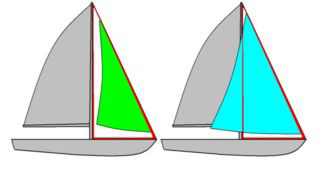
A jib, left, compared to a roughly 150%
genoa, right. The foretriangle is outlined
in red.
The term genoa is often used somewhat
interchangeably with jib, but technically there
is a clear delineation. A jib is only as large as the
foretriangle, which is the triangular area formed by the
mast,
deck or
bowsprit, and
forestay. A genoa is larger, with the
leech going past the mast and overlapping the
mainsail. To maximize sail area the foot of the sail is
generally parallel and very close to the deck when close
hauled. Genoas are categorized by the percentage of
overlap. This is calculated by looking at the distance
along a perpendicular line from the luff of the genoa to
the clew, called the LP (for "luff perpendicular"). A
150% genoa would have an LP 50% larger than the
foretriangle length.
Gennaker
A gennaker is a
recently-developed
sail used when
sailing
downwind; it can be described as a cross
between a
genoa and a
spinnaker. It is asymmetric like a genoa,
but, the gennaker is not attached to the
forestay over the full length of its
luff, being rigged like a spinnaker. The
gennaker has a larger camber than a genoa,
making it optimal for generating lift at larger
angles of attack, but the
camber is significantly less than that of a
spinnaker
The gennaker is a specialty sail
primarily used on
racing boats, bridging the performance gap
between a genoa, which develops maximum driving
force when the
apparent wind angle is between 35 and 60
degrees, and a spinnaker, which has maximum
power when the apparent wind is between 100 and
140 degrees. Due to its geometry, the sail is
less prone to collapsing than a spinnaker and
does not require the use of
spinnaker pole. The lines between gennaker
and asymmetric spinnaker are blurry; they are
both high camber downwind sails, rigged
similarly to a genoa. The difference is the
amount of camber, which dictates the points of
sail. A gennaker is optimal for a
beam reach, while an asymmetric spinnaker is
optimal for a
broad reach or
run.
Jib

A typical jib on a small
yacht
A jib is a triangular
staysail set ahead of the foremost
mast of a sailing boat. Its
tack is fixed to the
bowsprit, to the bow, or to the deck
between the bowsprit and the foremost
mast.
Jibs and
spinnakers are the two main types of
headsails on a modern yacht.
Confusingly, any jib is technically a
staysail, but the inner jib of a
yacht with two jibs is called the
staysail, and the outer
(foremost) the jib. This
combination of two jibs is called a
cutter rig or a Yankee pair.
(Definitions of what counts as a
"cutter" differ between Europe and
America). A yacht with one mast rigged
with two jibs and a mainsail is called a
cutter.
A fully rigged
schooner has three jibs. The
foremost one sets on the topmast
forestay and is called the jib
topsail, a second on the main
forestay is called the jib,
and the innermost is called the
staysail. All three sails are
both jibs and staysails in the generic
sense.
A square-rigged ship typically has
four jibs, though vessels with more and
fewer exist. Starting from the inside,
these sails are called:
-
Fore (topmast)
staysail
-
Inner jib
-
Outer jib
-
Flying jib
On yachts with only one jib, it is
common for the
clew of the jib to be further aft
than the mast, meaning the jib and
mainsail overlap. An overlapping jib is
called a genoa jib or simply a
genoa.
On cruising yachts with more than one
jib, it is common for the innermost one
to be self-tacking, either by using a
boom along the foot of the sail, or
by cleating the jib
sheet to a track, or both. On other
cruising yachts, and nearly all racing
sailboats, the jib needs to be worked
when tacking. On these yachts, there are
two sheets attached to the
clew of the jib. As the yacht comes
head to wind during a tack, the active
sheet is released, and the other sheet
(the lazy sheet) on the other
side of the boat is pulled in. This
sheet becomes the new active sheet
until the next tack.
Spinnaker
.

Bear of Britain, a Farr 52 with masthead
spinnaker in front of
Calshot Spit
A spinnaker is a special type of
sail that is designed specifically for
sailing off the wind from a reaching
course to a downwind. The spinnaker
fills with wind and balloons out in front of the boat
when it is deployed, called flying. It is
constructed of very lightweight, usually
nylon<, fabric, and is often brightly colored. The
spinnaker is often called a chute, as it somewhat
resembles a
parachute in both construction and appearance, or a
kite. It may be optimized
for a particular range of wind angles, as either a
reaching or a running spinnaker.
|


